For 1,000 years Christians have met for prayer on this site. The oldest surviving part of the building is the great Norman tower which you saw on your way in, standing watch over Sandwich for more than 850 years. The Rector welcomes you on this first part of our audio tour.
Prefer to listen to the Audio Tour as a playlist? Click here.
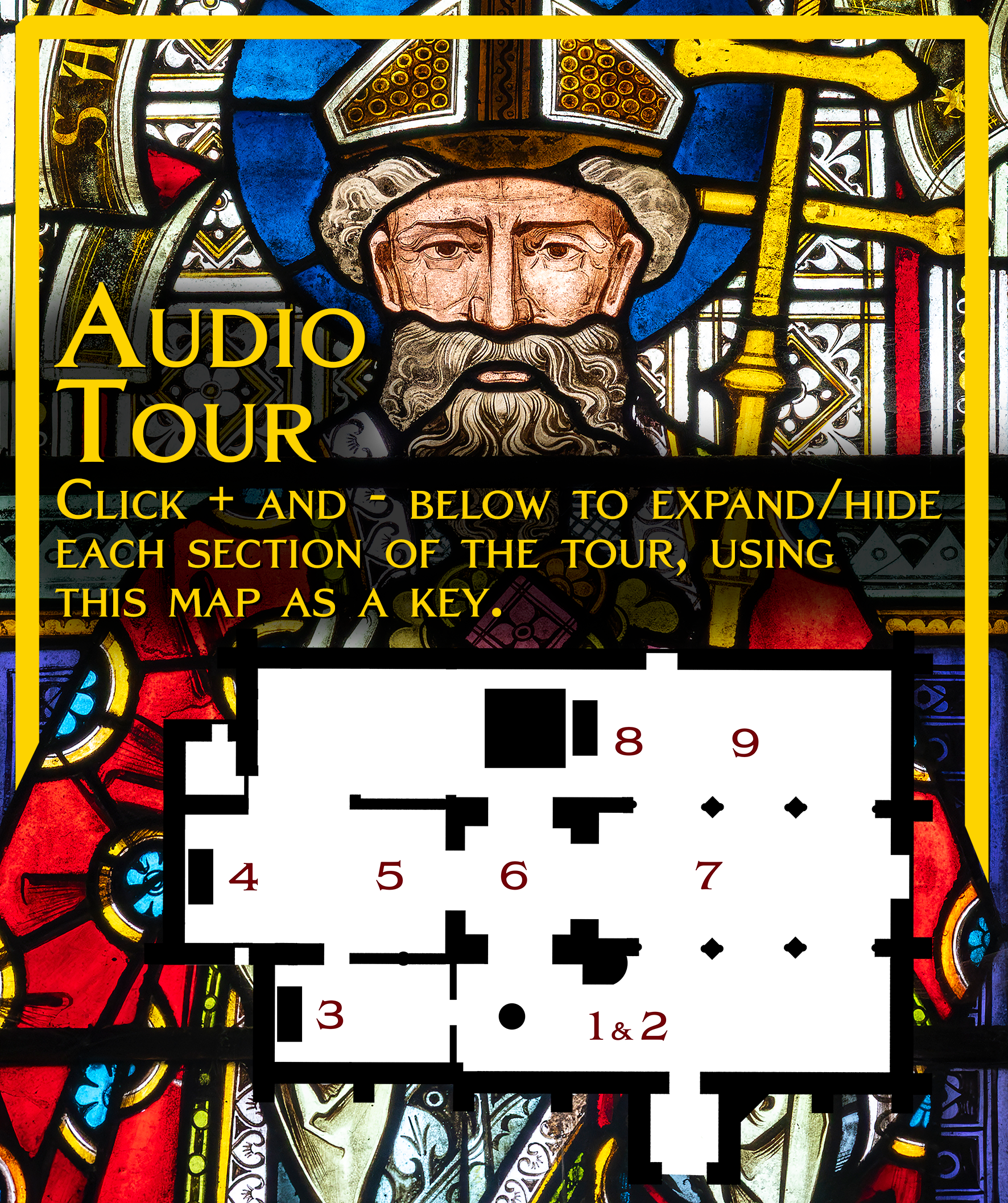
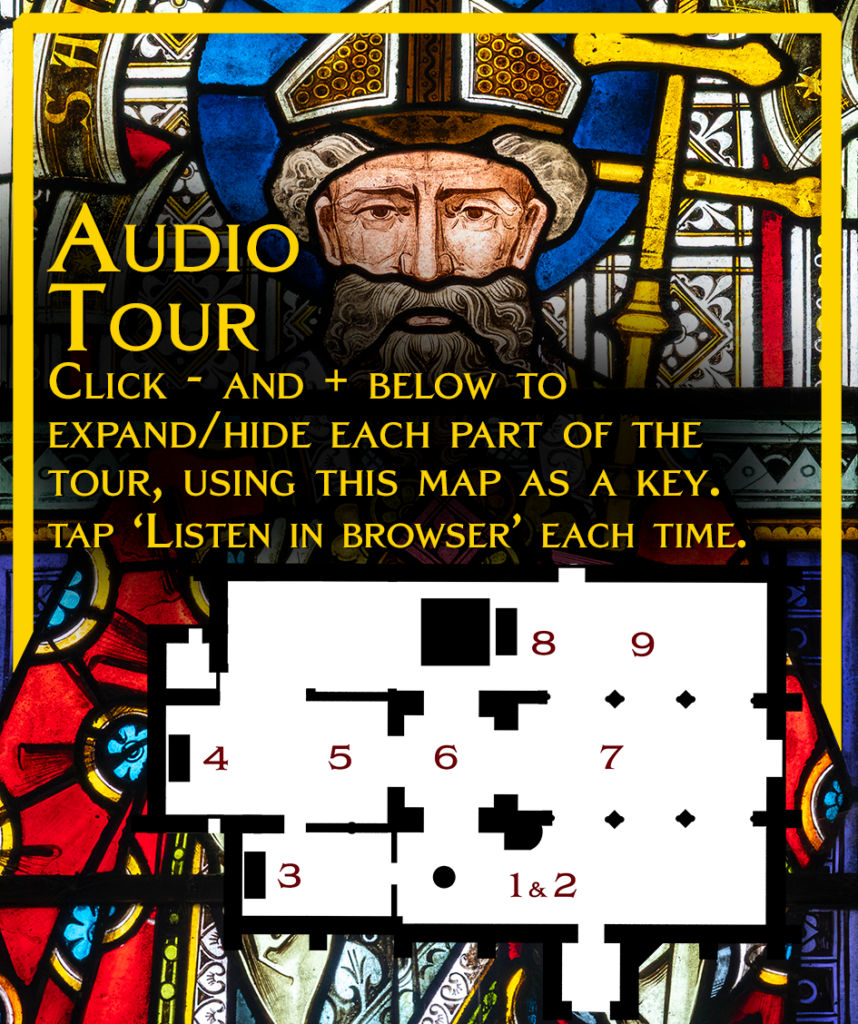
ON A PHONE: Important, tap ‘Listen in Browser’ each time, then the play button.
Optional: Opening Prayer
Our tour begins at the North Porch, through which you just entered, which since 1655 has been fitted with fine wooden doors bearing the initials of those who were almost certainly the Puritan Churchwardens here. Above the porch is the parvis – or ‘priest’s’ – room, potentially a place where a priest or visitor once slept, and at one time served as a family pew with an opening on to the church that has since been blocked up.
But the true first stop must be the font, the place of Baptism in St Clement’s since around 1405. For more than 600 years infants and adults have been baptised in this beautiful carved treasure. Originally it would have been kept full of holy water, blessed each year at Easter, and a hinged lid would have been used to secure the water – the mark of the original hinges can be seen today. Select the option to hear a detailed walkabout tour of this extraordinary font, and the even older nearby medieval treasure – the early Norman tympanum carving above the doorway to the belltower, with its mysterious creatures.
Near the font is the parish chest, dated 1634. Again this chest has the initials of those who were almost certainly Churchwardens, showing the great importance of the role in the life of the church and community over the centuries. The chest once held vital legal and financial documents, and is fitted with three locks. Only when the Vicar and two Churchwardens each unlocked with their key could the contents be accessed.
But before you move on, also look down at the floor, especially around the curve of the tower’s spiral staircase, where a good number of medieval tiles remain with their beautiful decorations.
The font
Optional: Detailed tour of the font
Walk through the wooden screen, given by the parishioners in 1914 in memory of noted former Vicar Arthur Manners Chichester, and into the Chapel of St Margaret. Take in the floor, which still has many original medieval tiles.
This is a place of prayer, and the Aumbry cupboard, covered with a curtain, with its light that you see on the north wall contains the Blessed Sacrament – the bread that was consecrated during the Eucharist to be for us the Body of Christ.
St Margaret’s has an unusual gradus or gospel step, where after many centuries the Gospel continues to be read during services. The column holding the arches up is of the 13th century, and look up – the timberwork dates from the 14th century. In the west wall, by the altar, you will see a very large ‘squint’, the large hole in the wall, designed so that two Masses could be said simultaneously, one in this chapel and one at the High Altar.
Look over the altar rail at the memorial stone set in the floor on the north side of the altar, the same side as the aumbry cupboard previously mentioned. This was originally a headstone outside in the churchyard, brought in to pave the floor! How fortunate that it was, because we have a nicely preserved inscription recording the death of twelve year old John Broughton in 1676. Beneath the inscription we can – remarkably – see where the stonemason practised carving the letters in a place he knew would be hidden in the earth.
This chapel is still in use regularly, often using the words of the Book of Common Prayer from 1662.
St Margaret’s Chapel
Walk through, minding the step, to the chancel, and take in the large high altar. The mensa, the altar stone itself, has been in St Clement’s since well before the Reformation. When Edward VI ordered all altars removed, during the changes of the Reformation, the stone was set into the ground as a memorial stone. It was the famous architect Augustus Pugin, designer of the Houses of Parliament among many other projects, who travelled from his home in nearby Ramsgate, and realized what the stone was from its five crosses – anointed many centuries ago by the bishop at the stone’s consecration to represent the five wounds of Christ upon the cross. Pugin knelt, kissed the stone, and encouraged its restoration as the altar.
Apart from during Lent, the six large candlesticks bear, from the left, the Royal Coat of Arms, the combined Arms of His Majesty King Charles III and the house of Shand, from which Queen Camilla descends, the Arms of the Cinque Ports, the anchor as the symbol of St Clement, the Archbishop of Canterbury’s arms, and an image representing the Blessed Virgin Mary as the ‘star of the sea’, sure guide to her Son. The two smaller candlesticks bear the five wounds of Christ, and lilies representing again the Blessed Virgin Mary.
If you’re lucky enough to be visiting on a sunny day, light will be shining through the three stained glass windows above you illuminating St Peter and St Paul, and in the middle St Clement himself, again clutching his anchor. St Clement was the fourth Bishop of Rome, by tradition consecrated bishop by St Peter, who under the Roman persecutions of Christians was tied to an anchor and thrown into the sea. As patron saint of mariners this dedication was most suitable for Sandwich, a vital port 1,000 years ago.
Behind the altar are fine Victorian tiles, early examples of tiles of the gothic revival style, whitewashed for more than a century, but the tiles were restored for Easter 2026, and unveiled with great fanfare at the Easter Vigil.
The High Altar
Walk between the wooden stalls, which date from the 15th century. It is uncertain whether these were simply for a choir to use, or for monastic use, or for important merchants who formed confraternities for mutual support and prayer.
One stall is still fitted with its original ‘misericord’, a special seat which can be lifted up or down, with a small shelf to lean against underneath. This provides some comfort during long periods of standing during services, and the underside is beautifully carved.
Note the round holes under the base of the choir stalls, and the corresponding holes higher up in the walls beside the High Altar. Inside these holes are ceramic acoustic jars, designed to help the sound of plainchant to fill the church. Today the Choir of St Clement’s continue to play a large part in our worship of God, singing here and across the country.
Medieval Choir Stalls
Walk down into the crossing of the tower, and take in the sheer scale of its ‘crossing piers’, the technical term for the columns holding it up. This tower is highly unusual in Kent, and ranks as one of the foremost Norman towers in the country.
Peer up to the carvings at the top of the crossing piers, with foliage as well as faces. Some with Norman-esque masks seem to be in the style of the so-called ‘green man’, perhaps the beaded ribbons issuing from their mouths are a reference to the French language spoken by the Norman conquerors, looking down on their Saxon subjects.
In 1661 the central tower of St Peter’s, in Sandwich, crashed into the south aisle, and in 1668 the other parish church, St Mary’s, suffered the collapse of its own central tower. Here at St Clement’s, concern was already being expressed about the poor condition of the Norman tower. It appears that since 1530 this had been crowned with a spire which acted as a landmark for shipping. It was decided that this must be removed in 1670, much against the wishes of the sea pilots who lodged a formal protest.
The nineteenth century surgeon Laidlaw Purves would take in the view from the top of the tower and exclaim “By George, what a place for a golf course”, going on to found the nearby world-class Royal St George’s Golf Club (the exclamation of Dr Purves apparently inspiring its dedication and name).
Directly above you, on the other side of the ceiling, is the ringing chamber, and above that the bell chamber. There have been four sets of bells over the course of St Clement’s history. We know that there were bells here at the time of a will dated 1492, but in 1672 a new peal of bells was installed. Sadly all bar one was removed during the 19th century, when an inspection found that their weight was causing the stonework to begin to crack. A replacement set of tubular bells continued to call out for around a century before the current ring of six bells was installed thanks to St John the Baptist, Kirkheaten (near Huddersfield, who had been given a new ring of eight bells), the Redundant Bells Fund of the Central Council of Church Bell Ringers, and the generosity and hard work of the local community here in Sandwich. They rang out for Easter Day 1990, and Her Late Majesty Queen Elizabeth the Queen Mother, then Lord Warden of the Cinque Ports, visited for their baptism (for bells are ‘baptised’ rather than ‘blessed’).
The Crossing
Optional: Tour of the ringing room above
Walk through into the nave, the name of which comes from the Latin navis meaning ship. Looking up at the ceiling you can get a sense of the underside of a ship, and this is the space where the congregation gather to go together on their journey of prayer into heaven.
This is likely to be the site of at least some of the Saxon church, look up at the tower from the nave and you can see the lowest mark of the Saxon roofline which once joined it. The earliest record we have of St Clement’s is from around 1050. It recounts the visit of King St Edward the Confessor to St Clement’s, and the remarkable vision of Earl Leofric received during a Mass. Edward had a keen interest in the Cinque Ports as a first line of defence, and his presence in Sandwich is just one of many royal visits, and one of two known visits by canonised saints.
Though many of our medieval brasses have been lost over the centuries, as you can see some still remain in the floor at the head of the nave – take in the figure of what is believed to be a merchant, judging from the money purse dangling in his hand, with his wife.
Looking up, this ceiling dates from the late 15th century, replacing one likely burnt during the French invasion of 1457. Again on the tower you can see the slightly higher echo of that second, Norman roofline. The current ceiling is a highly unusual example in Kent, and its angelic figures a rare survival of a pre-Reformation image of the hosts of Heaven.
If you’re able, consider lying down on a pew and really taking in the beauty of this ceiling. If you’d like, select the option to hear an extract from the original text of ‘The Vision of Leofric’, the account of St Edward’s visit.
The Nave
Optional: ‘The Vision of Leofric’ – original account of St Edward’s visit
Move into the south aisle, and admire the organ, behind which lies modern meeting rooms.
This current organ was built by Nicholsons of Malvern, and the inaugural recital was given by Dr Peter Hurford in June 1995. It is a versatile instrument enabling music from all periods of the organ repertoire to be convincingly interpreted as well as providing effective accompaniment to the liturgy. The organ has 1,430 pipes and is played from two manuals with pedals and with largely mechanical action.
The instrument is housed in a fine case of mainly English oak and was designed by Anthony Hall. The majority of the pipework was not new but taken from the previous 1950 three manual instrument built by A E Davies and Sons of Northampton, housed at the West end of the North and South Aisles.
In 2023 the instrument was overhauled and cleaned by Anthony Hall’s own company Clevedon Organs Ltd. A mechanical swell octave coupler was added together with a bell stop called a Zimbelstern.
A mechanical organ like this requires much love, and a lot of financial support, and St Clement’s owes much to the wider community who have helped ensure that we can continue to rejoice in the sound of such a fine instrument.
The Organ
Optional: The Election of Mayors
Walk down the south aisle to the south-west corner of the church, but pause on your way and take in the memorial stone on the wall to Wing Commander Robert Stanford Tuck. He was one of the great heroes of the Battle of Britain and, after the war, grew mushrooms nearby, remarkably making peace with those he had fought against, and even receiving some of the Luftwaffe pilots, such as General Adolf Galland, here as reconciled visitors and friends. St Clement’s itself was spared, other than some minor bomb damage, but houses very nearby were among the seven destroyed during air raids in Sandwich, and we must count ourselves very blessed to continue to have St Clement’s.
In the south-west corner itself you will find the restored Chapel of St Thomas Becket. We know the position of the original chapel from wills, and also from the two busts carved into the window on the outside. Note them when you leave the building, either side of the window lighting you now. One appears to be wearing a mitre, and the other a crown. Perhaps these are Becket himself, and Henry II? This is a place of quiet prayer, and you are very welcome to pause and light a candle here.
We have a unique connection with Thomas Becket here in Sandwich, for it was here that he returned to England from his exile in France on 1st December 1170. He set out the following day, surrounded by the townsfolk of Sandwich, to reach Canterbury Cathedral, where he would be martyred on the 29th December.
The South Aisle
We invite you to listen to our full-cast reconstruction of St Thomas Becket’s return to Sandwich, and the events which occurred in Canterbury Cathedral just 28 days later.
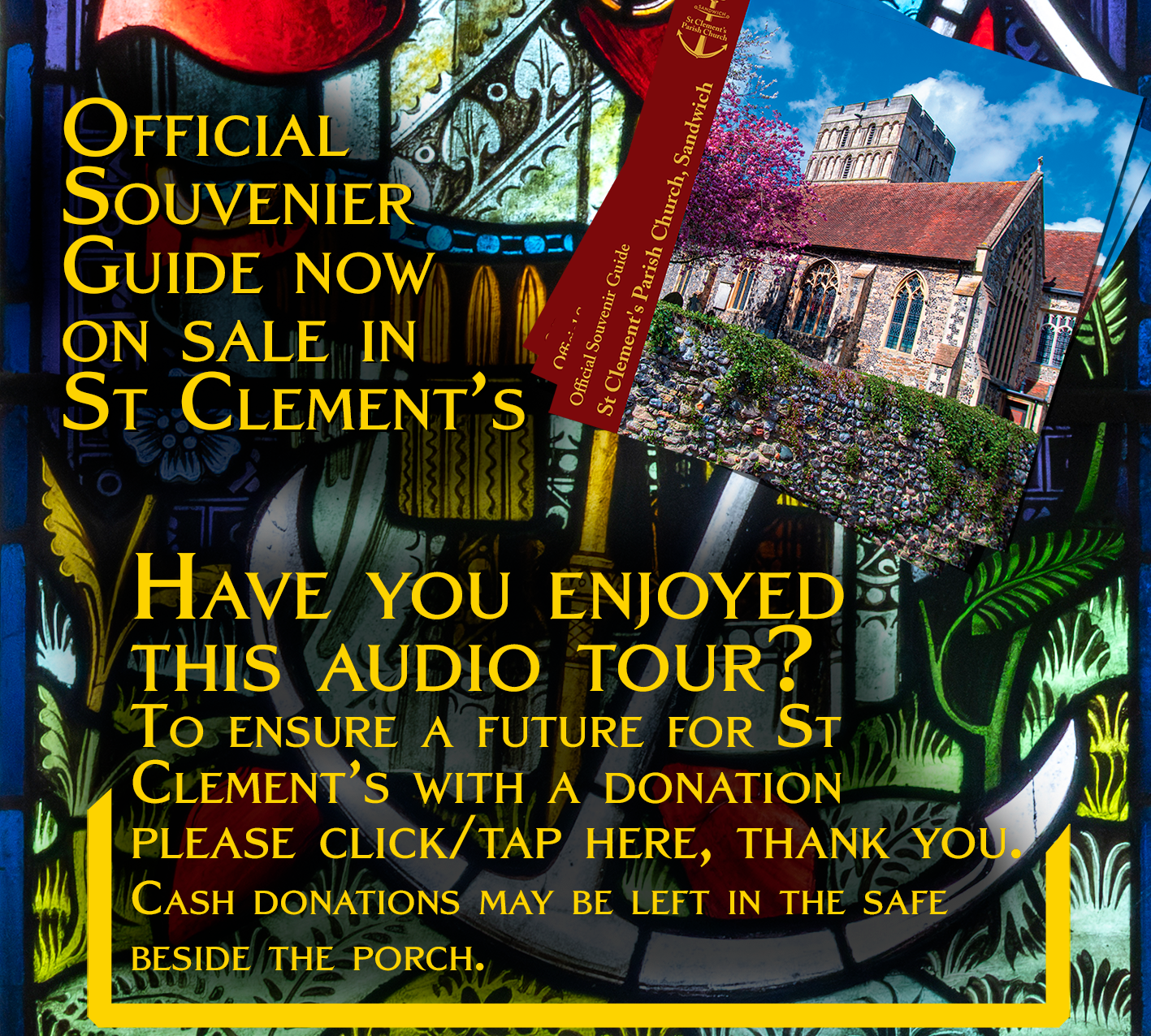
The Rector writes: “This marks the end of our internal tour of St Clement’s. We hope that this visit stays in your mind, and we would love to see you again – particularly at our worship. If you are able to make a donation towards keeping this ancient place open we would be extremely grateful, and if it is your custom please do spare a prayer for those who continue to minister and worship here today. If you’d like to learn more about St Clement’s, a full-colour detailed guidebook is available to purchase.
I leave you with music from our wonderful organ, though you may wish to listen to an optional recording as well, a poem called ‘The Pilgrimage of Grace’, written by a Victorian curate of St Clement’s, which describes a spiritual walk through the Church from the west doors up to the high altar.
Then feel free to move on to the external tour, being guided around our Churchyard to visit some of the most fascinating graves, learning about some of the individuals buried here over many centuries.
May you be blessed through the remainder of your time in our wonderful, and historic, ancient town and Cinque Port – Sandwich.”
Farewell!
Optional: The Pilgrimage of Grace poem
Welcome The Rector
(Optional) Opening Prayer The Right Reverend Rose Hudson-Wilkin
The Entrance Mo Hare
(Optional) Detailed Walk Around the Font Robert Pay
St Margaret’s Chapel Emma Montgomery
The High Altar Val Oates
The Medieval Choir Stalls Phil Price
The Crossing Diane Coller (Dr Purves: Douglas Gordon)
(Optional) The Ringing Room Martin Thorley and Bruce Williams
The Nave Dawn Baxter-Phillips
(Optional) St Edward’s Visit Howard Evans
The Organ Julian Sampson
(Optional) The Election of Mayors The Right Worshipful the Mayor of Sandwich, Councillor Emmet Csuka
The South Aisle Rhys Llewellyn-Harries
Thomas Becket Audio Drama
Thomas Becket – The Right Reverend Doctor Michael Turnbull
Also starring, in order of appearance:
Narrator – Emma Sarjeant
John of Oxford – Barry Brooks
Gunter – Kevin Wright
The Sheriff – Rhys Llewellyn-Harries
Henry II – The Lord Warden of the Cinque Ports, Sir George Zambellas
The Priests – The Reverend Sebastian Hamilton and The Reverend Howard Pashley
The Knights – Bruce Williams, Martin Thorley, Dylan Thorley
The Spirits – Dawn Baxter-Phillips
The congregation of St Clement’s appear as the crowds
Finale The Rector
The Pilgrimage of Grace Ann Harrison-Brooks